E quando as palavras nos tocam de tal modo que a nossa vontade é abraçá-las?
Não vos aconteceu já a todos aquando de lerem, por exemplo, um livro, darem de caras com um pedaço maior ou menor, o qual só vos apetece guardar para nunca mais esquecer?
E porque não partilhar tais pedaços com outrens?
In bed that night I invented a special drain that would be underneath every pillow in New York, and would connect to the reservoir. Whenever people cried themselves to sleep, the tears would all go to the same place, and in the morning the weatherman could report if the water level of the Reservoir of Tears had gone up or down, and you could know if New York was in heavy boots. And when something really terrible happened – like a nuclear bomb, or at least a biological weapons attack – and extremely loud siren would go off, telling everyone to get to Central Park to put sandbags around the reservoir.
The next morning I told Mom I couldn’t go to school again. She asked what was wrong. I told her, “The same thing that’s always wrong.” “You’re sick?” “I’m sad.” “About Dad?” “About everything.” She sat down on the bed next to me, even though I knew she was in a hurry. “What’s everything?” I started counting on my fingers: “The meat and dairy products in our refrigerator, fistfights, car accidents, Larry –“ “Who’s Larry?” “The homeless guy in front of the Museum of Natural History who always says ‘I promise it’s for food’ after he asks for money.” She turned around and zipped her dress while I kept counting. “How you don’t know who Larry is, even though you probably see him all the time, how Buckminster just sleeps and eats and goes to the bathroom and has no raison d’être, the short ugly guy with no neck who takes tickets at the IMAX theatre, how the sun is going to explode one day, how every birthday I always get at least one thing I already have, poor people who get fat because they eat junk food because it’s cheaper. . .” That was when I ran out of fingers, but my list was just getting started, and I wanted it to be long, because I knew she wouldn’t leave while I was still going. “. . . domesticated animals, how I have a domesticated animal, nightmares, Microsoft Windows, old people who sit around all day because no one remembers to spend time with them and they’re embarrassed to ask people to spend time with them, secrets, dial phones, how Chinese waitresses smile even when there’s nothing funny or happy, and also how Chinese people own Mexican restaurants but Mexican people never own Chinese restaurants, mirrors, tape decks, my unpopularity at school, Grandma’s coupons, storage facilities, people who don’t know what the Internet is, bad handwriting, beautiful songs, how there won’t be humans in fifty years –” “Who said there won’t be humans in fifty years?” I asked her, “Are you an optimist or a pessimist?” She looked at her watch and said, “I’m optimistic.” “Then I have some bad news for you, because humans are going to destroy each other as soon as it becomes easy enough to, which will be very soon.” “Why do beautiful songs make you sad?” “Because they aren’t true.” “Never?” “Nothing is beautiful and true.” She smiled, but in a way that wasn’t just happy, and said, “You sound just like Dad.”
To my unborn child: I haven’t always been silent, I used to talk and talk and talk and talk, I couldn’t keep my mouth shut, the silence overtook me like a cancer, it was one of my first meals in America, I tried to tell the waiter, “The way you just handed me that knife, that reminds me of –” but I couldn’t finish the sentence, her name wouldn’t come, I tried again, it wouldn’t come, she was locked inside me, how strange, I thought, how frustrating, how pathetic, how sad, I took a pen from my pocket and wrote ”Anna” on my napkin, it happened again two days later, and then again the following day, she was the only thing I wanted to talk about, it kept happening, when I didn’t have a pen, I’d write “Anna” in the air – backward and right to left – so that the person I was speaking with could see, and when I was on the phone I’d dial the numbers – 2, 6, 6, 2 – so that the person could hear what I couldn’t, myself, say. “And” was the next word I lost, probably because it was so close to her name, what a simple word to say, what a profound word to lose, I had to say “ampersand”, which sounded ridiculous, but there it is, “I’d like a coffee ampersand something sweet,” nobody would choose to be like that. “Want” was a word I lost early on, which is not to say that I stopped wanting things – I wanted things more – I juststopped being able to express the want, so instead I said “desire”, “I desire two rolls,” I would tell the baker, but that wasn’t quite right, the meaning of my thoughts started to float away from me, like leaves that fall from a tree into a river, I was the three, the world was the river. I lost “come” one afternoon with the dogs in the park, I lost “fine” as the barber turned me toward the mirror, I lost “shame” – the verb and the noun in the same moment; it was a shame. I lost “carry”, I lost the things I carried – “daybook,” “pencil,” “pocket change,” “wallet” – I even lost “loss.” After a time, I had only a handful of words left, if someone did something nice for me, I would tell him, “The thing that comes before ‘you’re welcome,’” if I was hungry, I’d point at my stomach and say, “I am the opposite of full,” I’d lost “yes,” but still had “no,” so if someone asked me, “Are you Thomas?” I would answer, “Not no,” but then I lost “no,” I went to a tattoo parlor and had YES written onto the palm of my left hand, and NO onto my right palm, what can I say, it hasn’t made life wonderful, it’s made life possible, when I rub my hands against each other in the middle of the winter I am warming myself with the friction of YES and NO, when I clap my hands I am showing my appreciation through the uniting and parting of YES and NO, I signify “book” by peeling open my clapped hands, every book, for me, is the balance of YES and NO, even this one, my last one, especially this one. Does it break my heart, of course, every moment of every day, into more pieces than my heart was made of, I never thought myself as quiet, much less silent, I never thought about things at all, everything changed, the distance between the wedged itself between me and my happiness wasn’t the world, it wasn’t the bombs and the burning buildings, it was me, my thinking, the cancer of never letting go, is ignorance bliss, I don’t know, but it’s so painful to think, and tell me, what did thinking ever do for me, to what great place did thinking ever bring me? I think and think and think, I’ve thought myself out of happiness a million times, but never once into it. “I” was the last word I was able to speak aloud, which is a terrible thing, but there it is, I would walk around the neighborhood saying “I I I I.” “You want a cup of coffee, Thomas?” “I.” “And maybe something sweet?” “I.” “How about this weather?” “I.” “You look upset. Is anything wrong?” I wanted to say, “Of course,” I wanted to ask, “Is anything right?” I wanted topull the thread, unravel the scarf of my silent and start again from the beginning, but instead I said, “I.” I know I’m not alone in this disease, you hear the old people in the street and some of them are moaning, “Ay yay yay,” but some of them are clinging to their last word, “I,” they’re saying, because they’re desperate, it’s not a complaint it’s a prayer, and then I lost “I” and my silence was complete. I started carrying blank books like this one around, which I would fill with all the things I couldn’t say, that’s how it started, if I wanted two rolls of bread from the baker, I would write “I want two rolls” on the next blank page and show it to him, and if I needed help from someone, I’d write “Help,” and if something made me want to laugh, I’d write “Ha ha ha!” and instead of singing in the shower I would write out the lyrics of my favourite songs, the ink would turn the water blue or red or green, and the music would run down my legs, at the end of each day I would take the book to bed with me and read through the pages of my life:
I want two rolls
And I wouldn’t say no to something sweet
I’m sorry, this is the smallest I’ve got
Start spreading the news...
The regular, please
Thank you, but I’m about to burst
I’m not sure, but it’s late
Help
Ha ha ha!
It wasn’t unusual for me to run out of blank pages before the end of the day, so should I have to say something to someone on the street or in the bakery or at the bus stop, the best I could do was flip back through the daybook and find the most fitting page to recycle, if someone asked me, “How are you feeling?” it might be that my best responde was to point at, “The regular, please,” or perhaps, “And I wouldn’t say no to something sweet,” when my only friend, Mr. Richter, suggested, “What if you tried to make a sculpture again? What’s the worst thing that could happen?” I shuffled halfway into the filled book: “I’m not sure, but it’s late.” I went through hundreds ofbooks, thousands of them, they were all over the apartment, I used them as doorstops and paperweights, I stacked them if I needed to reach something, I slid them under the legs of wobbly tables, I used them as trivets and coasters, to line the birdcages and to swat insects from whom I begged forgiveness, I never thought of my books as being special, only necessary, I might rip out a page – “I’m sorry, this is the smallest I’ve got” – to wipe up some mess, or empty a whole day to pack up the emergency light bulbs, I remember spending an afternoon with Mr. Richter in the Central Park Zoo, I went weighted down with food for the animals, only someone who’d never been an animal would put up a sign saying not to feed them, Mr. Richter told a joke, I tossed hamburguer to the lions, he rattled the cages with his laughter, the animals went to the corners, we were determined to ignore whatever needed to be ignored, to build a new world from nothing if nothing in our world could be salvaged, it was one of the best days of my life, a day during which I lived my life and didn’t think about my life at all. Later that year, when snow started to hide the frontsteps, when morning became evening as I sat on the sofa, buried under everything I’d lost, I made a fire and used my laughter for kindling: “Ha ha ha!” “Ha ha ha!” “Ha ha ha!” “Ha ha ha!” I was already out of words when I met your mother, that may have been our marriage possible, she never had to know me. We met at the Columbian Bakery on Brodway, we’d both come to New York lonely, broken and confused, I was sitting in the corner stirring cream into coffee, around and around like a little solar system, the place was half empty but the slid right up next to me, “You’ve lost everything,” she said, as if we were sharing a secret, “I can see.” If I’d been someone else in a different world I’d’ve done something different, but I was myself, and the world was the world, so I was silent, “It’s OK,” she whispered, her mouth too close to my ear, “Me too. You can probably see it from across a room. It’s not like being Italian. We stick out like sore thumbs. Look at how they look. Maybe they don’t know that we’ve lost everything, but they know something’s off.” She was the tree and also the river flowing away from the three, “There are worse things,” she said, “worse than being like us. Look, at least we’re alive,” I could see that she wanted those last words back, but the current was too strong, “And the weather is one hundred dollars, also, don’t let me forget to mention,” I stirred my coffee. “But I hear it’s supposed to get crummy tonight. Or that’s what the man on the radio said, anyway,” I shrugged, I didn’t know what “crummy” meant, “I was gonna go buy some tuna fish at the A&P. I clipped some coupons from the Post this morning. They’re five cans for the price of three. What a deal! I don’t even like tuna fish. It gives me stomachaches, to be frank. But you can’t beat that price,” she was trying to make me laugh, but I shrugged my shoulders and stirred my coffee, “I don’t know anymore,” she said. “The weather is one hundred dollars, and the man on the radio says it’s gonna get crummy tonight, so maybe I should go to the park instead, even if I burn easily. And anyway, it’s not like I’m gonna eat the tunna fish tonight, right? Or ever, if I’m being frank. It gives me stomachaches, to be perfectly frank. So there’s no rush in that department. But the weather, now that won’t stick around. Or at last it never has. And I should tell you also that my doctor says getting out is good for me. My eyes are crummy, and he says I don’t get out nearly enough, and that if I got out a little more, if I were a little less afraid...” She was extending a hand that I didn’t know how to take, so I broke its fingers with my silence, she said, “You don’t want to talk to me, do you?” I took my daybook out of my knapsack and found the next blank page, the second to last. “I don’t speak,” I wrote. “I’m sorry.” She looked at the piece of paper, then at me, then back at the piece of paper, she covered her eyes with her hands and cried, tears seeped between her fingers and collected in the little webs, she cried and cried and cried, there weren’t any napkins nearby, so I ripped the page from the book – “I don’t speak. I’m sorry.” – and used it to dry her cheeks, my explanation and apology ran down her face like mascara, she took my pen from me and wrote on the next blank page of my daybook, the final one:
Please marry me
I flipped back and pointed at, “Ha ha ha!” She flipped forward and pointed at, “Please marry me.” I flipped back and pointed at, “I’m sorry, this is the smallest I’ve got.” She flipped forward and pointed at, “Please marry me.” I flipped back and pointed at, “I’m not sure, but it’s late.” She flipped forward and pointed at, “Please marry me,” and this time put her finger on “Please,” as if to hold down the page and end the conversation, or as if she were trying to push through the word and into what she really wanted to say. I thought about life, about my life, the embarrassments, the little coincidences, the shadows of alarm clocks on bedside tables. I thought about my small victories and everything I’d seen destroyed, I’d swum through mink coats on my parents’ bed whilethey hosted downstairs, I’d lost the only person I could have spent my only life with, I’d left behind a thousand tons of marble, I could have released sculptures, I could have released myself from the marble of myself. I’d experienced joy, but not nearly enough, could there be enough? The end of suffering does not justify the suffering, and so there is no end to suffering, what a mess I am, I thought, what a fool, how foolish and narrow, how worthless, how pinched and pathetic, how helpless. None of my pets know their own names, what kind of person am I? I lifted her finger like a record needle and flipped back, on page at a time:
Help
******************************
Este capítulo está postado na íntegra, pois achei-o tão bom que não consegui excluir nada. ^^
What about a teakettle? What if the spout opened and closed when the steam came out, so it would become a mouth, and it could whistle pretty melodies, or do Shakespeare, or just crack up with me? I could invent a teakettle that reads in Dad’s voice, so I could fall asleep, or maybe a set of kettles that sings the chorus of “Yellow Submarine,” which is a song by the Beatles, who I love, because entomology is one of my raisons d’être, which is a French expression that I know. Another good thing is that I could train my anus to talk when I farted. If I wanted to be extremely hilarious, I’d train it to say, “Wasn’t me!” every time I made an incredibly bad fart. And if I ever made an incredibly bad fart in the Hall of Mirrors, which is in Versailles, which is outside of Paris, which is in France, obviously, my anus would say, “Ce n’étais pas moi!”
What about little microphones? What if everyone swallowed them, and they played the sounds of our hearts through little speakers, which could be in the pouches of our overalls? When you skateboarded down the street at night you could hear everyone’s heartbeat, and they could hear yours, sort of like sonar. One weird thing is, I wonder if everyone’s hearts would start to beat at the same time, like how women who live together have their menstrual periods at the same time, which I know about, but don’t really want to know about. That would be so weird, except that the place in the hospital where babies are born would sound like a crystal chandelier in a houseboat, because the babies wouldn’t have had time to match up their heartbeats yet. And at the finish line at the end of the New York City Marathon it would sound like war.
(...)
My first jujitsu class was three and a half months ago. Self-defense was something that I was extremely curious about, for obvious reasons, and Mom thought it would be good for me to have a physical activity besides tambourining, so my first jujitsu class was three and a half months ago. There were fourteen kids in the class, and we all had on neat white robes. We practiced bowing, and then we were all sitting down Native American style, and then Sensei Mark asked me to go over to him. “Kick my privates,” he told me. That made me feel self-conscious. “Excusez-moi?” I told him. He spread his legs and told me, “I want you to kick my privates as hard as you can.” He put his hands at his sides, and took a breath in, and closed his eyes, and that’s how I knew that actually he meant business. “Jose,” I told him, and inside I was thinking, What the? He told me, “Go on guy. Destroy my privates.” “Destroy your privates?” With his eyes still closed he cracked up a lot and said, “You couldn’t destroy my privates if you tried. That’s what’s going on here. This is a demonstration of the well-trained body’s ability to absorb a direct blow. Now destroy my privates.” I told him, “I’m a pacifist,” and since most people my age don’t know what that means, I turned around and told the others, “I don’t think it’s right to destroy people’s privates. Ever.” Sensei Mark said, “Can I ask you something?” I turned back around and told him. “’Can I ask you something’ is asking me something.” He said, “Do you have dreams of becoming a jujutsu master?” “No,” I told him, even though I don’t have dreams of running the family jewelry business anymore. He said, “Do you want to know how a jujitsu student becomes a jujitsu master?” “I want to know everything,” I told him, but that isn’t true anymore either. He told me, “A jujitsu student becomes a jujitsu master by destroying his master’s privates.” I told him, “That’s fascinating.” My last jujitsu class was three and a half months ago.
(...)
Isn’t it so weird how the number of dead people is increasing even though the earth stays the same size, so that one day there isn’t going to be room to bury anyone anymore? (...) Anyway, the fascinating thing was that I read in National Geographic that there are more people alive now than have died in all of human history. In other words, if everyone wanted to play Hamlet at once, they couldn’t, because there aren’t enough skulls!
(...)
Actually, if limousines were extremely long, they wouldn’t need drivers. You could just get in the back seat, walk thorough the limousine, and then get out of the front seat, which would be where you wanted to go.
(...)
When you look up ‘hilarious’ in the dictionary, there’s a picture of you.
(...)
Mom said, “Honey,” and I said, “Oui,” and she said, “Did you give a copy of our apartment key to the mailman?” I thought it was so weird that she would mention that then, because it didn’t have to do with anything, but I thing she was looking for something to talk about that wasn’t the obvious thing. I said, “The mailperson is a mailwoman.” She nodded, but not exactly at me, and she asked if I’d given the mailwoman a key. I nodded yes, because I never used to lie to here before everything happened. I didn’t have a reason to. “Why did you do that?” she asked. So I told here, “Stan –” And she said, “Who?” And I said, “Stan, the doorman. Sometimes he runs around the corner for coffee, and I want to be sure all of my packages get to me, so I thought, if Alicia –” “Who?” “The mailwoman. If she had a key, she could leave things inside our door.” “But you can’t give a key to a stranger.” “We have lots of valuable things in our apartment.” “I know. We have really great things.” “Sometimes people who seem good end up being not as good as you might have hoped, you know? What if she had stolen your things?” “She wouldn’t.” “But what if?” “But she wouldn’t.” “Well, did she give you a key to her apartment?” She was obviously mad at me, but I didn’t know why. I hadn’t done anything wrong. Or if I had, I didn’t know what it was. And I definitely didn’t mean to do it. (...) “Maybe you could check with me next time, OK? “Don’t be mad at me,” I said, and I reached over Grandma and opened and closed the door’s lock a couple of times. “I’m not mad at you,” she said. “Not even a little?” “No.” “Do you still love me?” It didn’t seem like the perfect time to mention that I had already made copies of the key for the deliverer from Pizza Hut, and the UPS person, and also the nice guys from Greenpeace, so they could leave me articles on matanees and other animals that are going extinct when Stan is getting coffee. “I’ve never loved you more.”
(para ver posts relacionados basta clicarem na etiqueta 'Extremely Loud and Incredibly Close')
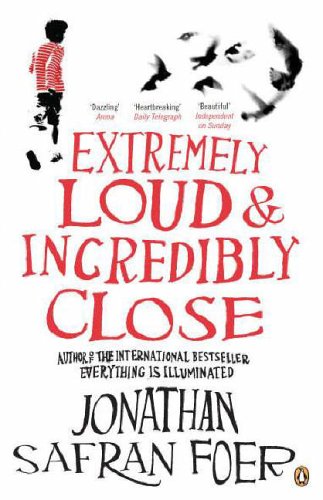
Extremely Loud & Incredibly Close é o nome do livro que comecei a ler ontem. Agarrou-me logo à primeira página. Resolvi, portanto, partilhá-lo convosco. Escolherei os melhores excertos de cada capítulo e irei postando à medida que for lendo, capítulo por capítulo. Espero que gostem! O autor é Jonathan Safran Foer. Deixo desde já aqui o seu resumo.
******************************
In a vase in a closet, a couple of years after his father died in 9/11, nine-year-old Oskar discovers a key...
The key belonged to his father, he's sure of that. But which of New York's 162 million locks does it open?
So begins a quest that takes Oskar - inventor, letter-writter and amateur detective - across New York's five boroughs and into the jumbled lives of friends, relatives and complete strangers. He gets heavy boots, he gives himself little bruises and he inches ever nearer to the heart of a family mystery that streches back fifty years. But will it take him any closer to, or even further from, his lost father?